

James Naismith invented basketball in 1891, and he did not do it by accident. He was responding to something specific: the competitive, winner-take-all logic of Gilded Age America, a culture so saturated in individual conquest that it was producing broken organizations, broken communities, and broken people. So he designed a game with no fixed positions, no reward for holding the ball, no barrier to entry, and no way to win alone. The design was the argument.
David Hollander’s How Basketball Can Save The World starts there and keeps pulling the thread. The book is genuinely strange in the best way. It moves from immigrant settlement houses on the Lower East Side to surveillance capitalism, from Julius Erving to Shoshana Zuboff, from cult psychology to organizational design, and somehow it holds. What connects all of it is a single uncomfortable pattern: systems built around the visible, the dominant, and the easily quantified consistently underperform systems built around relationship, access, and distribution.

That pattern is not limited to basketball. Most organizations would say they want collaboration, genuine development, and psychological safety. Most of them have also built structures that quietly reward the opposite. Hollander names the gap, traces it across 130 years, and offers something rarer than a solution: a working proof that it does not have to be this way.
What I found most useful about the book is that its best arguments are structural, not motivational. These are not calls to try harder or lead better. They are claims about design, and they hold up in environments well beyond sports.
Idea 1
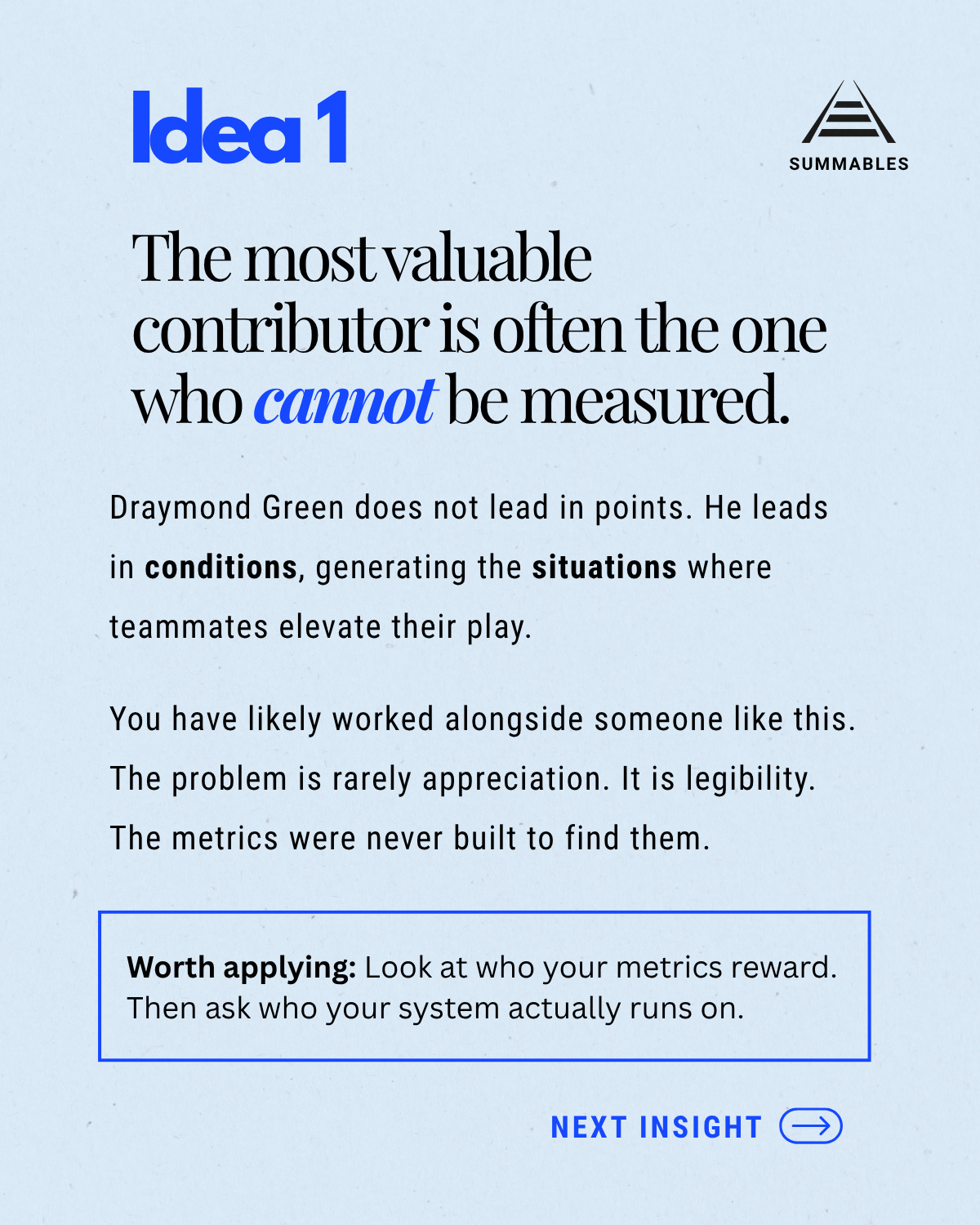
The most valuable person in a system is often the one the data cannot see.
Draymond Green does not lead in points. He rarely makes the highlight reel. What he does is harder to name: he generates conditions. He reads the whole floor, positions teammates before they know they need positioning, and creates the situations in which everyone around him performs closer to their ceiling. Standard metrics capture almost none of it.
The same person exists in almost every team and every organization. The one who holds the room together. The one who sees the full picture when everyone else is focused on their own column. The one whose departure, when it comes, takes months to diagnose because nothing specific broke, everything just got slightly harder. Organizations optimizing for visible output are losing these people quietly, often without realizing it until it is too late.
Worth applying: Look at what your metrics reward. Then ask who your team actually runs on. The answer is rarely the same person.
Idea 2
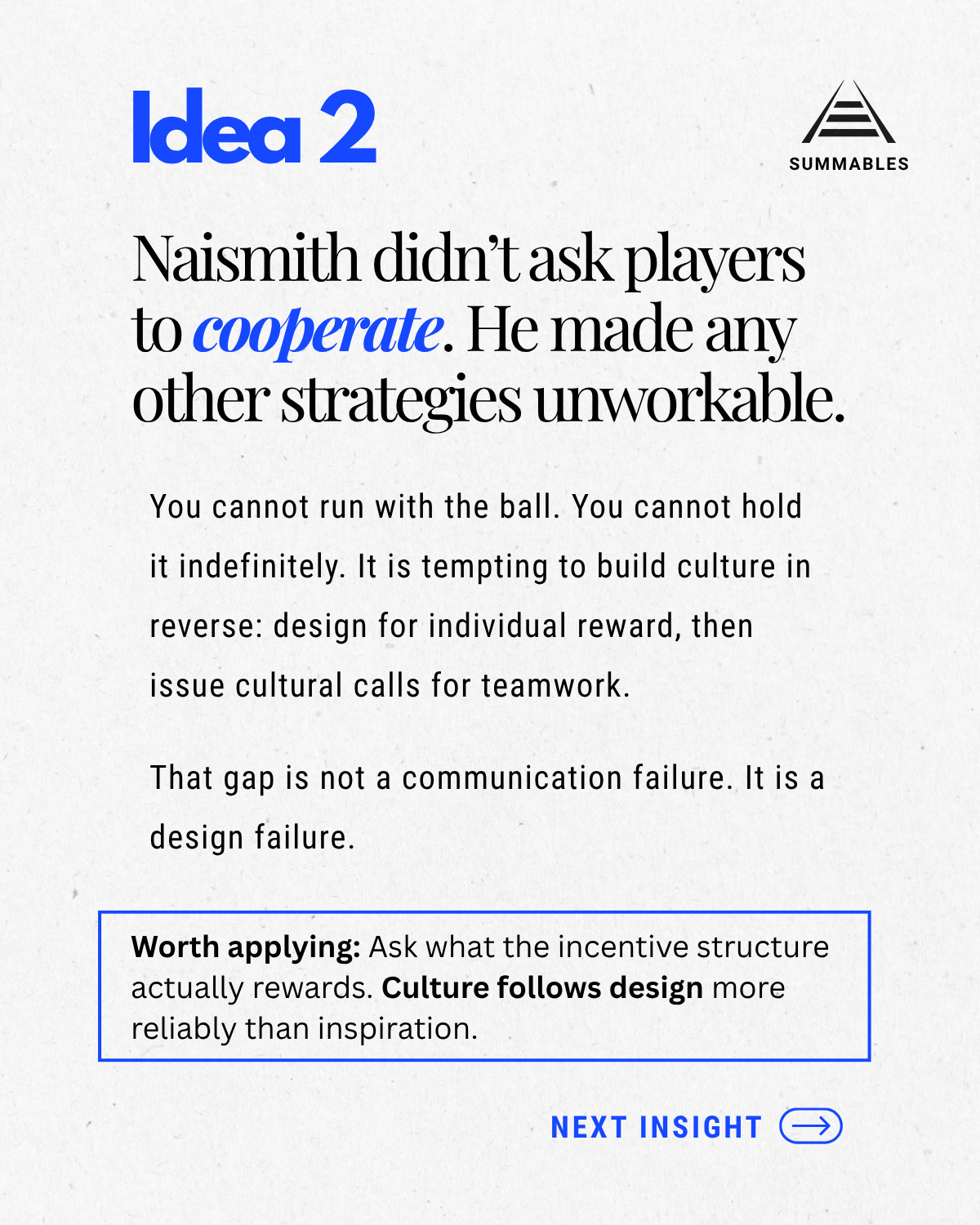
Naismith did not ask players to cooperate. He made any other strategy unworkable.
You cannot run with the ball. You cannot hold it indefinitely. Solo possession is not just inefficient. It is penalized. Cooperation had no real competition because the rules left no room for an alternative.
It’s easy for organizations to fall into patterns that do the opposite. They design for individual reward, track individual output, and then issue cultural calls for teamwork. The gap between what a structure actually incentivizes and what its culture claims to want is not a communication failure. It is a design failure, and it is surprisingly common at every level of leadership. Inspiration rarely outlasts incentive. The design wins.
Worth applying: Before your next team initiative, ask what your incentive structure actually rewards. Culture follows design far more reliably than it follows inspiration.
Idea 3
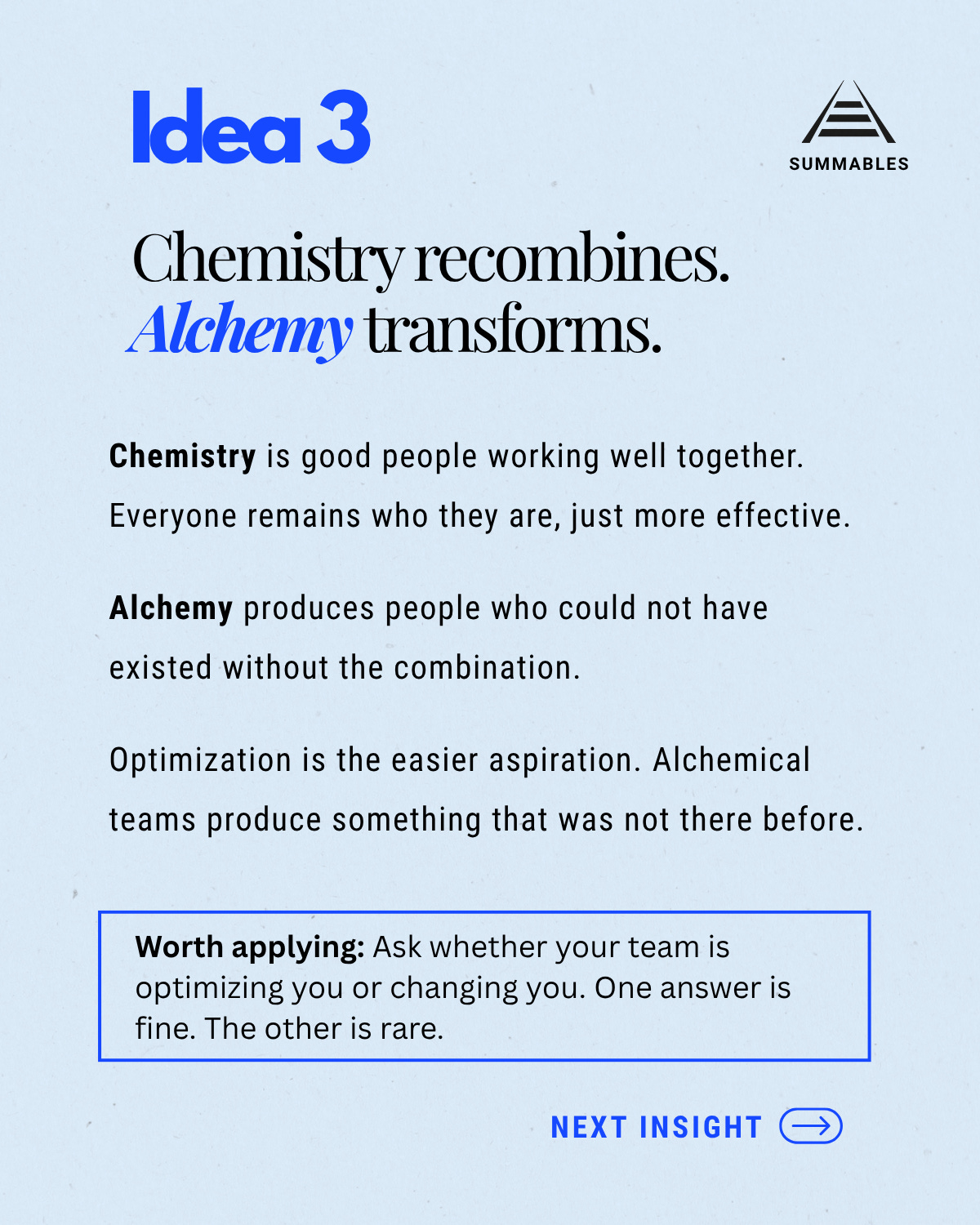
Chemistry recombines. Alchemy transforms.
The distinction Hollander draws here is one of those distinctions that feels obvious in retrospect and is easy to miss until someone names it clearly. Chemistry is what happens when good people work well together. Everyone stays essentially who they are, just more effective. It is also the ceiling that most teams never think to question.
Alchemy is different. It produces people who could not have existed before the combination. The 1975 Golden State Warriors turned Rick Barry into something he had never been before, something no one predicted.
That is more than optimization. That is transformation.
Most leadership thinking does not even aim for it, because you can forecast optimization. Transformation you can only recognize after the fact.
Worth applying: Ask whether your team is optimizing you or changing you. One answer is perfectly fine. The other is rare, and worth noticing when it is present.
Idea 4
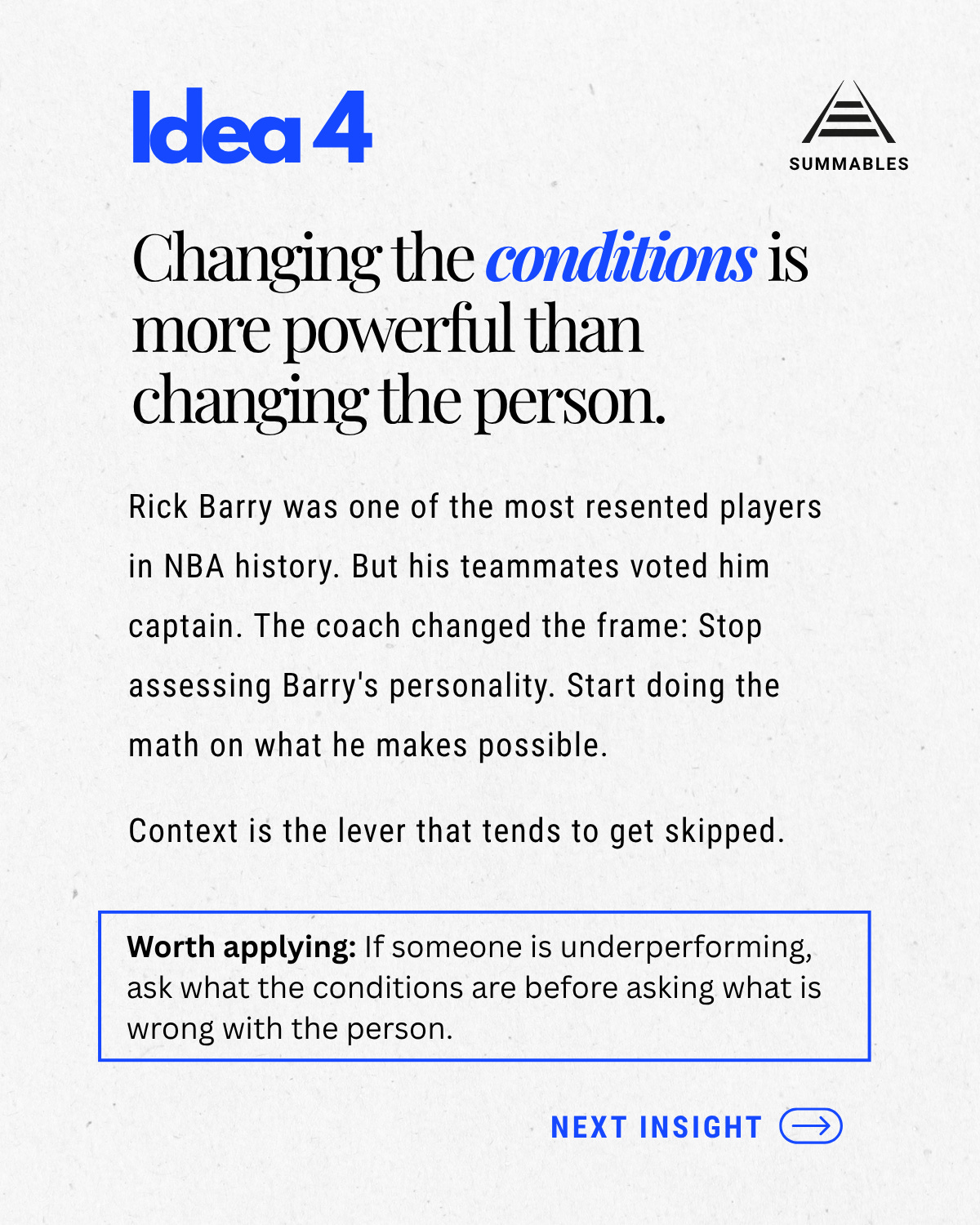
Changing the context is more powerful than changing the person.
Rick Barry was one of the most resented players in the league for most of his career. By 1975, his teammates voted him captain. He did not reform himself through self-improvement or character development. Clifford Ray changed the frame. He asked the team to stop assessing Barry’s personality and start doing the math on what Barry actually made possible when given the right conditions and the right role.
Leaders spend enormous effort trying to change people through feedback, coaching, direct confrontation, and performance management. All of that has its place. But context is a faster lever, a more reliable lever, and most leaders systematically underuse it because it requires rethinking structure rather than simply addressing behavior.
Worth applying: The next time someone is underperforming, ask what the conditions are before asking what is wrong with the person.
Idea 5
Sanctuary is not a wellness benefit. It is the condition for having an interior life.
Hollander draws on Shoshana Zuboff to make this point, and it is the sharpest argument in the book. Surveillance capitalism is not simply a new business model. It is a claim to own human experience itself, to convert every action, every pause, every preference into behavioral data that can be packaged and sold. The earlier industrial era claimed ownership of human labor. This one claims something closer to human consciousness.
Naismith, perhaps accidentally, designed a counter to that. A space requiring no membership, no subscription, no data trail. Just a ball and a court. Hollander's argument is that rest, play, and genuine unmonitored time are not recovery tools layered on top of a productive life. They are the conditions under which a person remains a self, and removing them does not produce a more efficient person. It produces a hollowed-out one.
Worth applying: Design time into your own life, or your team’s, that belongs to no one and produces nothing. That is not generosity. It is protection.
The Gymnasium
What stays with me most is the book’s refusal to be comforting. It does not end with a playbook or a framework or a list of things to implement by Friday. It ends with a quieter provocation: that we have had a working proof of better system design for over a century, embedded in a game played in parks and gymnasiums around the world, and we keep finding ways to not apply it where it matters most.
That is not a failure of knowledge. It is a failure of design. The values most organizations claim to hold, collaboration, equity, development, autonomy, are not naturally occurring. They have to be structurally supported or they will not survive contact with the incentives that surround them.
Naismith understood that. Most books about systems end with a framework.
This one ends with a gymnasium.

Beyond the Signals
There is no shortage of interesting ideas. The harder question is which ones actually change how you work, how you lead, or how you build. Summables exists for that second question. Each edition goes looking for the substance that makes an idea stick beyond the week you read it.